
When teams explore an AI prototype generator for their next product, two names appear again and again: YouWare and Lovable. Both convert natural-language ideas into working apps and interfaces. Both make it possible for non-engineers to ship sophisticated experiences.
This article will not pick a “winner.” Instead, it will help you answer a more practical question:
If you are User Type A, when should you choose Lovable? If you are User Type B, when is YouWare the better fit?
Along the way, we will clarify what is an AI prototype generator, where the two products overlap, and where YouWare has built a distinctive moat around its integrated backend and creator community.
What Is An AI Prototype Generator?

At its core, an AI prototype generator is a tool that turns your descriptions—user stories, feature lists, or even Figma mockups—into interactive software. You describe the product; the system generates UI, logic, and often the data layer.
- YouWare lets you turn user stories or mockups into interactive, clickable prototypes in seconds and then refine them into dashboards, internal tools, and full web experiences.
- Lovable is an AI app and website builder that turns ideas into production-ready software without coding, positioning itself as a full-stack development platform powered by generative AI.
In practice, that means both products let you move from “idea in a document” to “clickable product in a browser” in minutes rather than weeks. The real difference is who they are designed for and what happens after the first prototype appears.
User Type A: When Lovable Is The Better Fit
If you recognize yourself in this profile, Lovable is probably the stronger choice:
- You are a founder, marketer, or product manager running many experiments in parallel.
- You care most about speed to a working, hosted app and less about how the underlying code is structured.
- You expect to spin up landing pages, SaaS MVPs, internal tools, and proof-of-concepts rapidly.
In this A-type scenario, Lovable excels:
- Chat-First, End-To-End Building
Lovable lets you describe the app you want in natural language and have AI generate a functional, modern application. It is explicitly positioned as a platform that converts ideas into production-ready applications. - Strong Integrations For Production Use
Lovable integrates with services like Supabase and Stripe so you can add authentication, databases, and payments without writing traditional backend code. Official docs and community tutorials show Lovable being used with Supabase and Stripe to power full SaaS products, including subscription billing and role-based access. - Market Traction And Ecosystem Momentum
Press coverage reports that Lovable has raised significant funding and is valued in the billion-dollar range, with tens of thousands of paying customers—clear evidence of a rapidly growing ecosystem and ongoing product investment.
In short, if you are User Type A—focused on shipping as many experiments as possible with minimal friction—Lovable is a very strong, pragmatic choice.
User Type B: When YouWare Is The Better Fit
Now consider a different persona:
- You are a creator, designer-founder, indie hacker, or “vibe coder” who cares about the craft behind your product.
- You want to own your code, understand how things work, and learn from what the AI generates.
- You are excited by a creative community where projects are shared, remixed, and improved together—not just deployed and abandoned.
If this is you, YouWare is typically the better home.
- A Creator-First AI Coding Platform
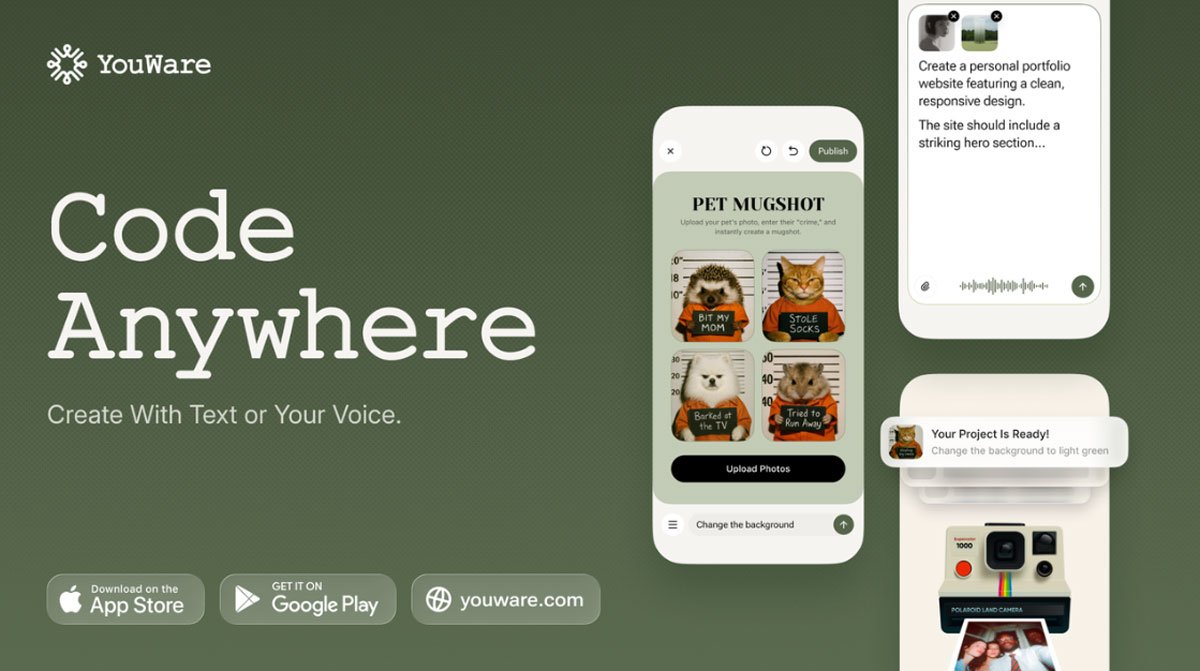
YouWare is positioned as an AI coding and creative platform: it helps users transform ideas into shareable web apps using natural language, code generation, and one-click deployment. It emphasizes low barriers, collaborative remixing, and a global community of AI coding creators. - Community, Remix, And Learning
Beyond simply generating apps, YouWare features mechanisms like project remixing and community showcases, encouraging users to fork others’ work, improve it, and learn from real examples. This collaborative culture is ideal for builders who want to grow their skills while shipping. - Integrated Backend Through YouBase / Backend MCP
Recent YouWare updates add comprehensive backend support: YouBase (also surfaced through a backend MCP) provides data storage, authentication, server-side logic, and file management as a built-in cloud backend for every project.
For User Type B, who cares about both speed and craftsmanship, YouWare feels less like a one-off builder and more like a creative operating system.
Shared Strengths: Where Both Platforms Shine
To keep the comparison fair, it is worth highlighting that both YouWare and Lovable are strong products with significant overlap:
- Natural-Language Driven Development
Both platforms let you start from a simple description such as “a customer feedback portal with an admin dashboard” and get a working UI with navigation, forms, and basic logic. - Rapid Prototyping To Hosted App
Each tool can take you from prototype to a live, hosted experience, significantly compressing implementation time for MVPs and internal tools. - Accessible To Non-Engineers
Designers, PMs, marketers, and founders are all able to drive implementation without waiting on a dedicated engineering team, making both platforms part of the broader “vibe coding” wave.
So the real question is not “Which is good?”—they both are. The question is: Which one matches how you like to build, learn, and grow your product?
YouWare’s Moat: Prototypes That Already Think Like Products
Where YouWare builds a distinct moat is in how it treats your prototype as a full-stack product from day one, thanks to its integrated backend stack.
1. YouBase: Backend As A First-Class Feature
According to YouWare’s own documentation, YouBase is its cloud backend that gives your project:
- Persistent data storage
- User authentication
- Server-side logic
- File management and more
Without YouBase, YouWare explicitly notes that an app is “just a pretty picture”: forms do not save data, users cannot log in, and nothing persists. With YouBase enabled, the app “remembers” user data and can deliver personalized experiences.
That means the default mode on YouWare is not just “screens and flows”; it is screens, flows, and a real backend that you can evolve without leaving the platform.
Lovable absolutely supports full-stack behavior as well—particularly when paired with Supabase, Stripe, and other services—but these integrations live as external pieces that you connect and manage. YouWare’s approach is more opinionated: every creator gets a consistent backend environment from the start.
2. A Story: From “Just A Prototype” To A Real Product On YouWare
To illustrate how this plays out, consider a composite (but representative) YouWare creator we will call Alex:
- Weekend Concept
Alex wants to build a small “studio booking hub” for local musicians—a place where bands can browse studios, pick a slot, and manage their upcoming sessions. On YouWare’s AI prototype generator, Alex types a short prompt describing roles (studio owner, musician), pages (listing, calendar, booking details), and the basic flow. - First Interactive Prototype
Within an hour, Alex has a clickable web app: navigation, booking forms, and basic views for studios and bands. At this stage, it still feels like a prototype—great for showing to friends, but not yet a product. - Turning On YouBase
Alex then enables YouBase for the project. Suddenly:- Musicians can sign up and log in.
- Studio owners can manage their listings and availability.
- Bookings are written to a real database, not just mocked out.
- A few lines of server-side logic prevent double-booking and send confirmation emails.
- Growing Through The Community
Alex shares the project on the YouWare community, receives suggestions on design, and remixes a layout from another popular project to improve the booking calendar. Over a few weeks, this “prototype” quietly becomes the real product local studios are using to manage their schedules.
The important part: Alex never has to migrate from a prototype builder to a separate production stack. The same environment—YouWare plus YouBase—handles ideation, prototyping, and production. That is the heart of YouWare’s moat.
How To Decide: A Simple Rule Of Thumb
You can summarize the choice like this:
- Choose Lovable if…
- You are User Type A: founder, marketer, PM running many experiments.
- You want a broad, general-purpose AI builder that can quickly generate apps and websites for a wide range of business cases.
- You are comfortable relying on external backend integrations and value Lovable’s strong ecosystem and rapid growth.
- Choose YouWare if…
- You are User Type B: creator, indie hacker, or learning-oriented builder who cares about the code and the craft.
- You want your AI prototype generator to ship with an integrated backend so your prototype behaves like a real product from day one.
- You value a community and remix culture where you can fork others’ projects, improve them, and showcase your own work.
Conclusion: Prototype Where You Plan To Stay
Both YouWare and Lovable are excellent answers to the question of what is an AI prototype generator in 2026. Lovable is ideal when you want to move extremely fast across many ideas and lean on a rapidly growing, production-oriented platform.
YouWare, by contrast, is built as a creative home for builders who want their prototypes to already think like products, with a first-class backend and a vibrant community around them.
If you are User Type A, Lovable may be the better fit.
If you are User Type B—creative, hands-on, and serious about product craft—YouWare is likely the ai prototype generator you will want to grow with.