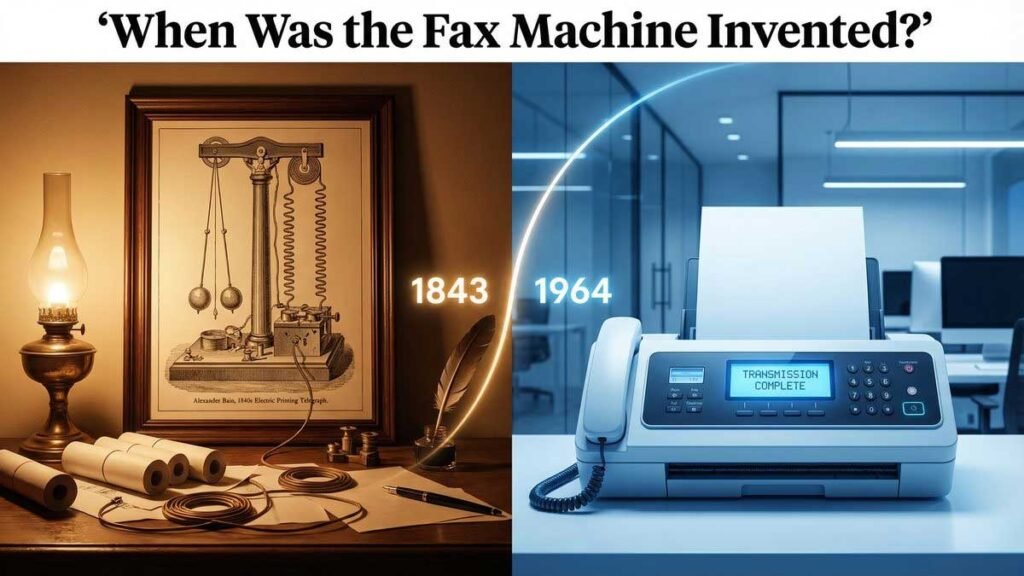
When you ask when the fax machine was invented, you might get two very different answers: 1843 and 1964. Both are correct, but they tell different parts of a fascinating story. One marks the moment a visionary Scottish clockmaker first patented the concept, decades before the telephone. The other marks the year a modern, office-ready machine finally brought that vision to the world.
This article provides the definitive history of the fax machine, from its surprisingly early origins to its peak in the 1980s and its unexpected relevance in our digital age. We’ll give you a clear timeline, bust some common myths, and explain exactly how this 180-year-old technology still plays a crucial role in the modern world.
The Short Answer: Two Key Dates in Fax History
Let’s clear up the confusion right away. The history of the fax machine hinges on two pivotal dates that represent its conceptual birth and its practical modernization.
First, we have 1843. This is the year the world was first introduced to the idea of sending an image over a wire. The credit goes to Alexander Bain, a Scottish inventor and clockmaker who secured British Patent #9745 for his “Electric Printing Telegraph.” This was the true invention of the facsimile machine — the birth of the concept.
Then, we have 1964, more than a century later. This is the year Xerox launched its Long Distance Xerography (LDX) machine, the first commercially successful device that we would recognize as a modern office fax machine. This was the birth of the practical, easy-to-use machine that eventually found its way into nearly every office.
In short, 1843 marks the invention of the idea, while 1964 marks the invention of the accessible, everyday machine. One is the spark of genius; the other is the fire it finally ignited.
The Forgotten Genius: Alexander Bain’s Electric Printing Telegraph
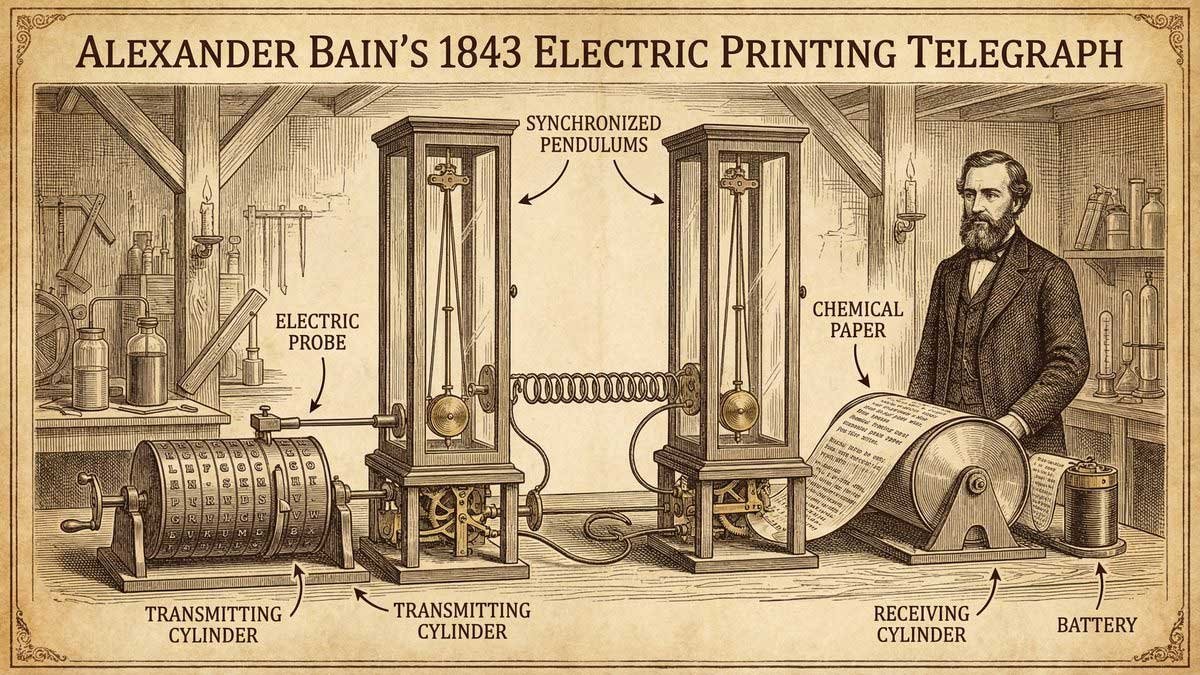
The story of the fax machine begins not in a modern corporate lab, but in the mind of Alexander Bain, a self-taught clockmaker from a small croft in rural Scotland. Born in 1810 in Watten, Caithness, Bain had a fascination with electricity and mechanics that led him to invent the world’s first device capable of transmitting an image over wires.
In 1843, he patented his creation: the “Electric Printing Telegraph.” The concept was revolutionary. It used a clock’s pendulum, swinging in perfect time, to scan a document made of raised metal letters. An electric probe passed over the letters, sending pulses down a telegraph wire. At the receiving end, a second pendulum — synchronized with the first — would swing over a roll of chemically treated paper, recreating the message line by line.
This was the world’s first facsimile machine. Bain had envisioned sending images over vast distances more than 30 years before Alexander Graham Bell would patent the telephone. His path to this invention was anything but conventional. He had no formal scientific education, having been apprenticed to a clockmaker in Wick as a young man. Yet his intuitive grasp of electricity and mechanics led him to one of the most prescient inventions of the 19th century.
While his machine was never a commercial success, the principle he established laid the groundwork for every fax machine that followed.
From Concept to Commerce: 19th-Century Pioneers Who Refined the Idea
Bain’s invention was a visionary first step, but other pioneers were needed to turn his concept into a commercial reality. The most significant of these was Italian physicist Giovanni Caselli, who created the Pantelegraph.
Caselli dramatically improved on Bain’s design by creating a more stable and reliable machine. In 1865, he launched the world’s first commercial fax service, transmitting documents between Paris and Lyon. Remarkably, this service was fully operational a full 11 years before the invention of the telephone. For the first time, businesses and governments could send a verifiable copy of a signature or a drawing over a long distance.
Other key inventors also pushed the technology forward. Frederick Bakewell improved image quality by replacing Bain’s pendulums with synchronized rotating cylinders, a design that would become standard for decades. Later, in 1880, Shelford Bidwell invented the scanning phototelegraph — the first device capable of scanning a two-dimensional image, not just raised metal letters. Around 1902, German physicist Arthur Korn developed the Bildtelegraph, which used photoelectric cells to transmit photographs, a technology quickly adopted by news agencies across Europe.
A Visual Timeline of the Fax Machine’s Evolution
To understand how we got from a swinging pendulum to near-instantaneous digital transmission, here is a timeline of the fax machine’s most important milestones.
| Year | Event | Inventor / Company | Significance |
|---|---|---|---|
| 1843 | Electric Printing Telegraph | Alexander Bain | The first patent for a facsimile machine is granted (British Patent #9745). |
| 1865 | Pantelegraph Service | Giovanni Caselli | The first commercial fax service launches between Paris and Lyon. |
| 1880 | Scanning Phototelegraph | Shelford Bidwell | The first machine capable of scanning a 2D original is invented. |
| ~1902 | Bildtelegraph (Photoelectric Scanning) | Arthur Korn | Enables the transmission of photographs over wires; adopted by news agencies. |
| 1924 | Transoceanic Radio Facsimile | RCA / Richard H. Ranger | The first photograph is sent wirelessly across the Atlantic Ocean. |
| 1964 | Long Distance Xerography (LDX) | Xerox | The first commercialized, modern office fax machine is introduced. |
| 1966 | Magnafax Telecopier | Xerox | A smaller (46 lbs), more practical office fax machine is released; connects to any standard phone line. |
| 1980 | ITU G3 Standard | ITU (led by NTT & KDDI, Japan) | A global standard is established, allowing all fax machines to communicate with each other. |
| 1985 | GammaFax | GammaLink | The first computer-based fax board is created, paving the way for digital faxing. |
| 1996+ | Internet Fax (FoIP) | Various | Fax over IP (FoIP) services emerge, allowing faxes to be sent via email and web interfaces. |
| 2010s | Mobile Fax Apps | Various | Smartphone apps make it possible to send and receive faxes from anywhere, without a physical machine. |
The 20th-Century Leap: How Xerox Made Fax a Household Name
The early 20th century saw crucial developments in transmitting images, which were vital for the newspaper industry. In 1924, Richard H. Ranger of RCA invented the wireless photoradiogram, sending the first photograph wirelessly across the Atlantic. A photo of President Calvin Coolidge, transmitted from New York to London on November 29, 1924, became the first picture reproduced by transoceanic radio facsimile. News agencies worldwide quickly adopted this technology.
But it was Xerox that finally made the fax machine an indispensable office tool. In 1964, the company introduced the Long Distance Xerography (LDX) machine. While still large and expensive, it was the first device that could send a high-quality copy of any document over standard telephone lines — no special equipment required at the other end.
Two years later, in 1966, Xerox released the Magnafax Telecopier. At 46 pounds, it was far smaller and more affordable, capable of transmitting a letter-sized document in about six minutes. For the first time, any business could easily and quickly send documents across the country, forever changing the pace of business communication.
The Golden Age: Japan’s Role and the Rise of Global Standards
The 1980s marked the golden age of the fax machine, and much of that boom was driven by innovation in Japan. While Xerox had created the modern office machine, it was Japanese companies that made it a truly global and affordable technology.
Japanese electronics firms poured resources into making fax machines smaller, faster, and more reliable. But their most crucial contribution was in establishing a universal standard. In 1980, led by Japan’s international telecom company KDD (now KDDI) and domestic provider NTT, the International Telecommunication Union (ITU) established the Group 3 (G3) facsimile standard.
This was a game-changer. For the first time, a fax machine made by any company, in any country, could communicate seamlessly with any other G3-compatible machine. This eliminated the fragmentation that had held back the technology for decades and created a single, global network. This universal standard, combined with falling prices, is what put a fax machine in nearly every office by the end of the decade.
Myth-Busting: 4 Common Misconceptions About the Fax Machine
Despite its long history, several myths about the fax machine persist. Here’s the truth behind the most common ones.
Myth 1: Xerox invented the fax machine.
This is perhaps the most common misconception. While Xerox commercialized the first modern office fax machine in 1964, Alexander Bain patented the original concept a full 121 years earlier, in 1843.
Myth 2: The telephone came first.
Surprisingly, the first commercial fax service — the Pantelegraph — was operating in France in 1865, a full 11 years before Alexander Graham Bell received his patent for the telephone in 1876.
Myth 3: Faxing is completely obsolete.
While it’s no longer a primary tool for personal communication, faxing remains a critical technology in regulated industries like healthcare, law, and finance. Its unique security features keep it not just alive, but legally mandated in many contexts.
Myth 4: Email is always more secure than fax.
This is a dangerous assumption. A standard, unencrypted email can be intercepted at multiple points as it travels across the internet. A traditional point-to-point fax transmission, which travels over a dedicated phone line, is significantly more secure from hacking and interception.
Why Is Fax Still Used Today? Security, Law, and Tradition
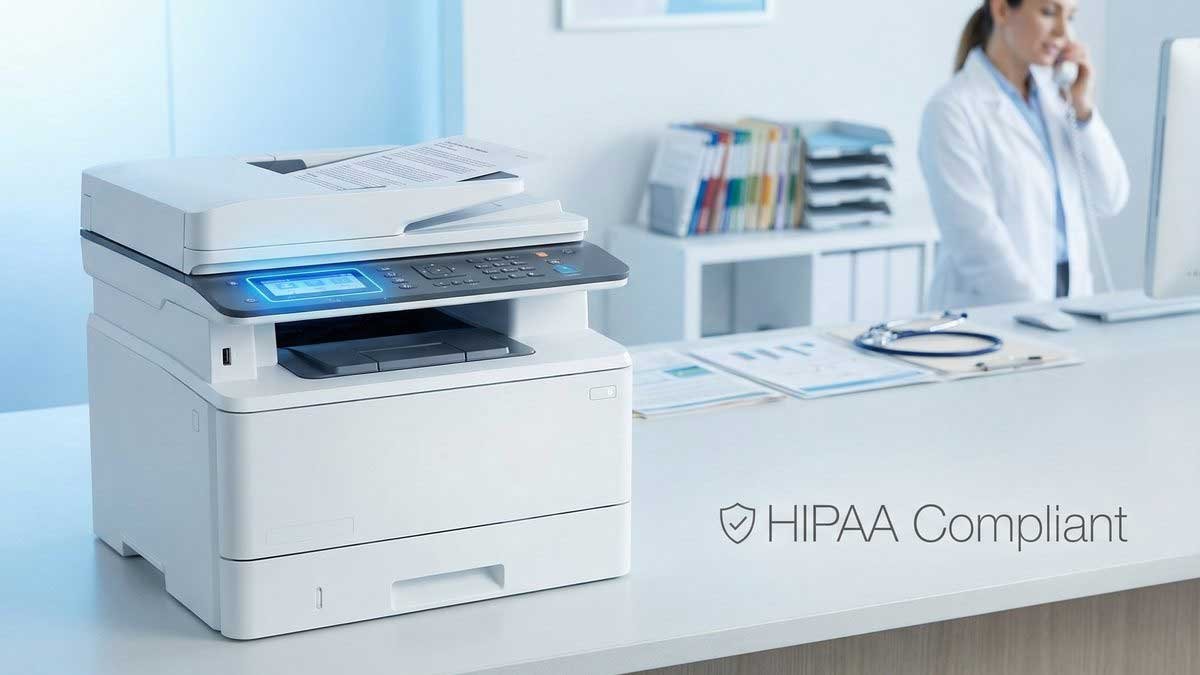
In an age of instant messaging and email, it might seem strange that fax machines are still in use. However, in several key sectors, faxing remains a vital tool for security, legal, and traditional reasons.
Healthcare and HIPAA Compliance
The healthcare industry is one of the largest users of fax technology. Regulations like the Health Insurance Portability and Accountability Act (HIPAA) require patient information to be transmitted securely. A traditional fax, which sends data directly from one machine to another over a phone line, is considered a secure, point-to-point method of communication. This makes it less vulnerable to interception than unencrypted email. Studies show that fax still accounts for roughly 70% of all communication in the U.S. healthcare sector.
Legal and Government Documents
In the legal and government worlds, a signature on a document can be everything. Faxes provide a simple way to transmit legally binding documents with verifiable signatures. Many court systems and government agencies were built on fax-based workflows and have been slow to adopt digital alternatives, partly due to the high security and verifiability standards required.
Japan’s Continued Reliance
In Japan, the fax machine remains a common fixture in both business and personal life. This is partly due to cultural reasons — such as the importance of handwritten communication — and partly due to established business practices. As of 2024, a significant portion of the Japanese workforce still uses fax machines regularly, and 77% of schools reported using fax as of early 2025.
Frequently Asked Questions (FAQ)
Who invented the fax machine?
The first facsimile concept was invented by Scottish inventor Alexander Bain, who patented his “Electric Printing Telegraph” on May 27, 1843. However, the first modern, commercially successful office fax machine was developed by Xerox in 1964.
When did fax machines become popular?
Fax machines became extremely popular in the 1980s after the ITU established the G3 global standard in 1980, which allowed machines from different manufacturers to communicate with each other. This standardization, combined with lower prices driven by Japanese manufacturers, made fax machines a staple in businesses worldwide.
How did the first fax machine work in 1843?
Alexander Bain’s 1843 machine used a pendulum to scan a surface of raised, metallic letters. An electric probe would read the letters and transmit electrical pulses over a telegraph wire. A synchronized pendulum at the other end would then recreate the image on chemically treated paper, line by line.
Is faxing still used today?
Yes. While it is no longer common for personal use, faxing is still heavily used in regulated industries like healthcare, law, and finance due to its security and legal standing. Many government agencies and businesses in countries like Japan also continue to use it as of 2025.
Did they have fax machines in the 70s?
Yes, but they were not as common as in the 1980s. Companies like Xerox had been producing office fax machines since the mid-1960s, and by the 1970s they were becoming faster and more widely adopted by large corporations. The real boom, however, came after the 1980 ITU G3 standard.
What was used before fax machines?
Before the fax machine, the primary method for long-distance document transmission was the telegraph, which sent messages using Morse code. For physical documents, businesses relied on postal services and private couriers. The telegraph could transmit text, but not images or signatures.
Why do some people say the fax machine was invented in 1964?
People often cite 1964 because that is when Xerox released the first commercially successful, modern office fax machine — the Long Distance Xerography (LDX). This machine made faxing practical for everyday business use, whereas the original 1843 invention was an experimental concept that never achieved commercial success in its time.
Is a fax more secure than email?
A traditional, point-to-point fax is generally considered more secure than an unencrypted email. Because it travels over a dedicated phone line directly between two machines, it is much harder to intercept than an email, which passes through multiple servers on its way to the recipient. This is one key reason healthcare and legal industries continue to prefer it.
Conclusion
From a Scottish clockmaker’s visionary sketch in 1843 to a Xerox machine that reshaped the modern office in 1964, the history of when the fax machine was invented is a story of remarkable persistence. It’s a technology that existed before the telephone yet adapted to thrive in the age of the internet.
While the clunky, paper-jamming machine of the 1980s may be a relic of the past, the core principle of the fax — sending a secure, verifiable document from one point to another — is more relevant than ever. Its spirit lives on, not just in the healthcare and legal industries that still depend on it, but in the instant, global communication we now take for granted.
Sources: Wikipedia: Fax | Wikipedia: Alexander Bain | ETHERFAX: Why Healthcare Still Uses Fax in 2025 | Asahi Shimbun: 77% of schools still use faxes