
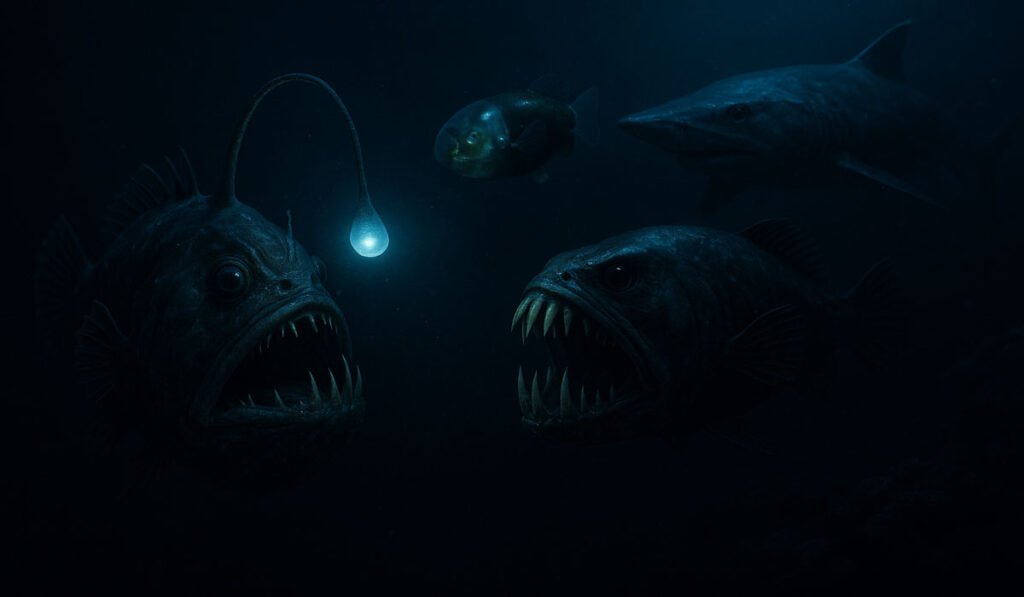
Have you ever wondered what lurks in the deepest, darkest parts of the ocean? It’s a realm of perpetual twilight, a world of crushing pressure and frigid temperatures where sunlight simply can’t reach.
This extreme environment, hostile to us, is a thriving home for some of the most bizarre and fascinating creatures on our planet. These inhabitants of the abyss have evolved in ways that are both beautiful and terrifying, perfectly adapted to a life of darkness and scarcity.
Let’s dive into the depths to uncover nine of the creepiest and most awe-inspiring creatures that haunt the deep sea.
Table of Contents
ToggleThe Anglerfish: A Master of Deception
Appearance and Bioluminescent Lure
The anglerfish looks like something straight out of a nightmare. It has a cavernous mouth filled with needle-sharp teeth and a fleshy, glowing lure dangling from its head.
This bioluminescent appendage, a product of symbiotic bacteria, acts as a deadly trap. It attracts unsuspecting prey in the inky blackness, drawing them closer.
The anglerfish remains perfectly still, a patient hunter waiting for a curious fish or crustacean to investigate the light before it strikes with lightning speed.
Parasitic Mating
As if its appearance wasn’t strange enough, the anglerfish has one of the most bizarre mating rituals in the animal kingdom. The male, just a fraction of the female’s size, has one purpose: to find a mate.
Once he does, he latches on with his teeth, and their bodies literally fuse together. The male’s organs wither away until he is little more than a parasitic appendage, providing sperm in exchange for nutrients from the female’s blood. It’s a permanent, parasitic embrace.
The Giant Isopod: The Ocean’s Oversized Roly-Poly
Deep-Sea Gigantism
Imagine a roly-poly from your garden, but blown up to the size of a small dog. That’s the giant isopod.
This creature is a prime example of deep-sea gigantism, a phenomenon where deep-sea animals grow to much larger sizes than their shallow-water relatives. Scientists believe this is an adaptation to the scarce food and extreme pressure.
A Scavenger’s Life
The giant isopod is a scavenger, a crucial part of the deep-sea cleanup crew. It roams the ocean floor, feeding on the carcasses of whales, fish, and squid that drift down from above.
With a slow metabolism, it can survive for long periods without food, a necessary adaptation in a world where the next meal is never guaranteed.
The Fangtooth Fish: All Teeth, No Compromise
Largest Teeth in the Ocean
The fangtooth fish may be small, but it boasts the largest teeth of any fish in the ocean relative to its body size. Its fangs are so long that it has evolved special sockets in its brain to hold them when its mouth is closed.
This fearsome-looking creature is a testament to the brutal reality of life in the deep, where every advantage, no matter how terrifying, is key to survival.
A Voracious Predator
Despite its intimidating look, the fangtooth isn’t a picky eater. It’s a voracious predator that will eat almost anything it can find.
Its hunting strategy is simple: open its massive mouth and suck in any unfortunate creature that strays too close. In the darkness, its oversized teeth ensure that once it has a grip, there is no escape.
The Barreleye Fish: The Fish with a Transparent Head
A Window to the Brain
The barreleye fish is one of the most peculiar creatures you’ll ever see. Its most striking feature is a transparent, fluid-filled head that offers a clear view of its internal, barrel-shaped eyes.
This see-through dome acts like a cockpit, allowing the fish to look up through the water for the faint silhouettes of prey against the dim light from above.
Rotating Eyes for Hunting
The barreleye’s eyes aren’t fixed in place. They can rotate, allowing the fish to look straight up or directly forward.
This unique adaptation gives it a wide field of vision, essential for hunting in the twilight zone. When it spots a meal, it can rotate its eyes forward to track it with precision.
The Goblin Shark: A Living Fossil with a Vicious Bite
Protruding Jaws
The goblin shark is a living fossil, a creature that has changed little in millions of years. Its most terrifying feature is its ability to protrude its jaws, shooting them forward to snatch prey.
This slingshot-like mechanism allows it to ambush unsuspecting fish and squid with incredible speed and a vicious bite.
A Rare and Mysterious Hunter
Because it lives so deep, the goblin shark is rarely seen by humans, which only adds to its mystery. Its pinkish-white skin and long, flattened snout give it an otherworldly appearance.
As a relic from a bygone era, it offers a glimpse into the ancient history of the ocean’s depths.
The Vampire Squid: Neither Vampire nor Squid
A Cloak of Darkness
The vampire squid is not a true squid, nor is it a vampire, but its name is certainly fitting. Its dark, webbed arms are lined with fleshy spines and can be spread out like a cloak.
This unique creature is a master of disguise, perfectly adapted to a life of stealth in the deep sea.
Unique Defense Mechanisms
When threatened, the vampire squid has a trick up its sleeve. Instead of ink, it releases a cloud of glowing mucus.
This sticky, bioluminescent substance can confuse and distract predators, allowing the vampire squid to make a quick escape into the surrounding darkness.
The Blobfish: More Than Just a Meme
The Pressure of the Deep
The blobfish became an internet sensation for its gelatinous, grumpy look when brought to the surface. But this unflattering image is just a result of the extreme change in pressure.
In its natural habitat, thousands of feet below the surface, the blobfish looks like a completely different animal.
A Gelatinous Survivor
In the crushing pressure of the deep sea, the blobfish’s gelatinous body provides all the support it needs. Its flesh is slightly less dense than water, allowing it to float effortlessly above the seafloor.
This helps it conserve energy as it waits for small crustaceans and other edible matter to drift by. It is a true survivor, perfectly adapted to one of the most inhospitable environments on Earth.
The Sea Pig: An Adorable Abyssal Dweller
A Type of Sea Cucumber
Despite its name, the sea pig is not a pig at all, but a type of sea cucumber. With its plump, pinkish body and leg-like tube feet, it has a charmingly peculiar appearance.
These creatures are a common sight on the abyssal plains, the vast, flat expanses of the deep ocean floor.
Herds on the Seafloor
Sea pigs are often found in large groups, or herds, moving slowly across the seafloor as they feed on decaying organic matter in the mud.
Their presence is a sign of a healthy deep-sea ecosystem, as they play a vital role in recycling nutrients. These adorable abyssal dwellers are a reminder that even in the darkest corners of the ocean, life can be surprisingly cute.
The Frilled Shark: A Serpent of the Deep
Prehistoric Appearance
The frilled shark is another living fossil, a creature that has haunted the deep for millions of years. With its long, eel-like body and multiple rows of sharp, three-pronged teeth, it has a distinctly prehistoric look.
This serpent of the deep is a formidable predator, a relic of a time when the oceans were ruled by ancient monsters.
A Flexible Hunter
The frilled shark has a unique hunting strategy. It can bend its body and strike like a snake, lunging forward to catch its prey.
Its flexible jaws allow it to swallow large prey whole, a necessary adaptation in an environment where meals are few and far between.
Conclusion
The deep sea is a world of extremes, a realm of darkness and pressure that has given rise to some of the most incredible and terrifying creatures on our planet.
From the glowing lure of the anglerfish to the transparent head of the barreleye, these creatures are a testament to the power of evolution and the endless wonders of the natural world.
As we continue to explore the ocean’s depths, we can only imagine what other mysteries and monsters lie waiting to be discovered.